Reducing crime in Kelowna is not an easy fix.
According to those in power, the solutions are found in a web of multiple levels of government, numerous organizations and the nuances of policy and law.
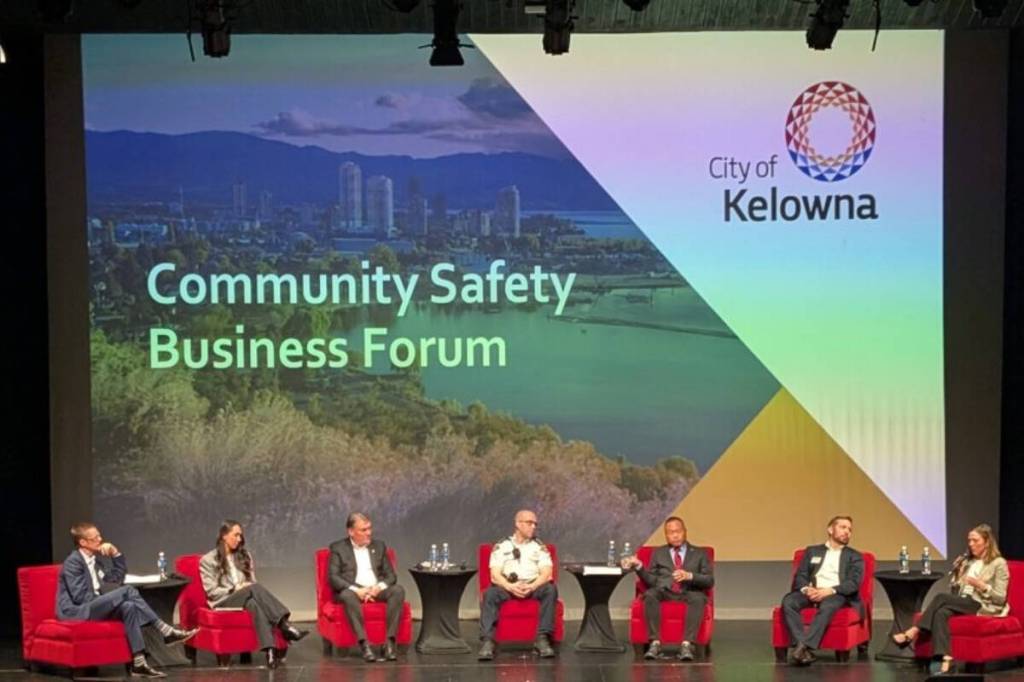
Still, those in Kelowna and the B.C. government attempted to outline the struggles and potential solutions of rampant crime to a crowd of business owners who are on the front lines of the issue on Tuesday, Jan. 27 at a Community Safety Business Forum held at the Kelowna Community Theatre. More than 100 residents were in attendance.
The panel – made of six members from various organizations – laid out the issues: that mental health and drug use combined with a “revolving door” justice system is responsible for a troubled segment of the population wreaking havoc on Kelowna businesses.
Mayor Tom Dyas, and others, say the solutions are found beyond the scope of what municipal governments and local law enforcement can do.
They call on help from higher governments, mostly in the form of systemic policy changes that will give law enforcement and prosecution more tools to keep offenders off the street. The panel urged higher levels of government to make these changes, and said public buy-in is key to make it happen.
Cracking down on repeat offenders
Kelowna is appealing to the federal government for reform of the bail system. Citing a city-published study, Dyas mentioned that at least 1,335 police files in 2024 were being generated by at only 15 repeat offenders, painting a picture of a “revolving door” justice system.
The Bail and Sentencing Reform Act (Bill-17) aims to change this, partly by accounting for prior criminal history when applying for bail. The bill is currently making it’s way through the House of Commons.
Dyas was not alone in this plea. He was joined by B.C. Minister of Community Safety Terry Yung.
“We have to protect the public like yourself, your businesses, your residents, from the prolific repeat offenders that continue to pray on us,” Yung said.
Dyas stated that another issue with the justice system is a shortage of Crown prosecutors.
Adam Dalrymple, the president of the BC Crown Counsel Association, was also a member of the Jan. 27 panel and advocated for further funding from the Province for more Crown prosecutors. He said Kelowna is a region – like many others in B.C. – that is currently undermanned by Crown counselors and that the Kelowna region needs at least five to 10 more.
“For decades, we’ve been trying to get more prosecutors for your community. We acknowledge it may not be the panacea. We know there’s not an endless pit of money, but it’s time to look objectively at the numbers. Recently, for example, I was told that of the 18 prosecutors that are currently in Kelowna, I understand that two have recently left to other jurisdictions,” Dalrymple said. “I’m told that there are charge assessments that have not been looked at.”
“We’re not perfect, but we can’t have hundreds of outstanding charges sitting a queue for prosecutors to review. I think that speaks volumes of that something’s wrong. We need more.”
According to Dalrymple, more bodies in the courts would mean files would be faster to process. He also called for further cooperation between prosecutors and the RCMP like in the ReVOII program.
However, senior manager Crown counsel in the Interior Jessica Patterson, said that “hiring Crown is unfortunately not a panacea to solve the street disorder in Kelowna.”
She called back to when Kelowna RCMP Supt. Chris Goebel said the RCMP often thinks they won’t get charges approved, countering by saying that drug possession falls under federal jurisdiction, falling under the Controlled Drugs and Substances Act.
She also said, by their responsibility, the provincial Crown is responding to all reports sent by police and that charge approval rates are in the region are similar to the rest of the B.C. As an aside, she mentioned their charge approval rates for property crimes is “very similar” to the rate of approval for crimes against the person.
Still, Patterson admitted that “we’re not perfect” and that there’s “a bit of a delay with some categories of offenses.”
During the forum, Yung did not say if more Crown prosecutors would be budgeted for.
Drug addiction and mental health
Another point hammered home during Tuesday’s forum was the need to properly take care of the population dealing with drug addiction.
Goebel said the issues of homelessness and drug addiction are linked to public disorder.
“You’re seeing open drug use around storefronts, you’re finding needles and paraphernalia where families and staff walk. You’re dealing with break and enters, smashed windows and repeated victimization. And increasingly, one of the more dangerous and unacceptable trends you’re seeing is fires. People light fire behind buildings and dumpsters,” he said.
Taking centre-stage on this issue was the push from Dyas and Goebel for the need for mandatory compassionate care.
“Leaving people publicly deteriorating is not compassionate,” said Goebel when speaking about the current state of the unhoused population dealing with drug issues. “It’s neglect and it’s not acceptable for the public.”
Dyas again echoed his point about a specific potential facility with the Okanagan Correctional Centre in Oliver, saying that currently there is no regional mandatory correctional centre.
“It has capacity for 378 beds. Currently there is less than 100 of them being used,” he said.
He added that he and other mayors and Chiefs of the Okanagan have signed a letter pushing for the Oliver site to be advanced.
Interior Health’s Jaymi Chernoff, chief operating officer of clinical services, was also on the panel. On mental healthcare, Chernoff said the work they can do is guided by government policy.
She mentioned the province is seeing “advancements” in changes that could be made that would allow for more involuntary care for people who aren’t in a good state of mind, citing Premier David Eby’s promise for more involuntary care beds as one of them as well as a potential review of the Mental Health Act.
“There are changes coming in in the form of that that will allow us some more levers to build to reach out to this population,” Chernoff said.
Yung also said B.C.’s Chief Scientific Advisor for Psychiatry and Toxic Drugs Daniel Vigo will be visiting Kelowna in the near future to “identify potential sites” for secure care.
Goebel and Yung also said that the end of the B.C.’s decriminalization pilot project on Jan . 31 will also have allow more freedom for law enforcement.
“The whole intent of decriminalization not being applied for an extension of that is to give the police more tools to actually enforce public safety, community safety,” Yung said. “Open drug use, in many aspects, is no longer acceptable, and the status quo is not working.”
Goebel said the RCMP will use these tools “as much as they possibly can” within law, adding that he opposed, saying he doesn’t support drug use in any capacity.
“If somebody is doing open drug use, which is in would be an arrestable offence that they would be arrested and searching someone to arrest and those drugs seized and taken away. But that’s kind of where it ends,” he said.
For healthcare, Chernoff said IH can’t say what the impacts of the end of decriminalization might be, but mentioned that it could lead to more people accessing healthcare services.
“Our goal is that they stay connected. They build a trust, they build a relationship and then we can get them on the path on the contium of care,” she said.
Dyas said he has always been critical of decriminalization. He is using the program’s end as proof that the city’s advocacy efforts against these policies is working.
Solutions now
While local politicians and RCMP are advocating for these policy changes and further resources, they also spoke about what is happening now to triage the problem.
At a municipal level, Dyas said the city has taken on many projects intending for community safety. Some of these include former initiatives such as expanding the local RCMP capacity by 33 members in 2023, or the restructuring of the rail trail and the tiny homes project, which aimed to create more stable conditions for the unhoused.
Recently, the City had announced more bylaw and RCMP patrols in the early morning and late night at targeted areas to reduce loitering, which Dyas said has seen success.
During the Jan. 27 business forum, two more projects were announced.
Through law enforcement, Goebel saiad Kelowna participiates in two provincial programs that target repeat offender, ReVOII and C-POII.
He also said the RCMP is working to improve police visibility and response times in high-risk areas, and that they are investing in technology that will administrative burden, freeing more time for officers.
They are attempting to crack down on organized crime with a recently launched gang-enforcement pilot.
Goebel also mentioned crime had over 60,000 files in 2025, 22,000 of which were high-risk priority 1 and 2 files.
Additonally, Yung mentioned another Kelowna enforcement program, Project Barcode which he said has resulted in 61 arrests and $1,100 of stolen property recovered.
Despite the discussion, a vocal contingent of the crowd was frustrated, some looking for more immediate solutions or feeling their questions went unanswered.
Dyas promised that the forum isn’t the last public communication on the matter of safety, and that information collected from the public will be put together by the city and communicated back.
link