Sampling and design
This study was a quasi-experimental with a control group that was conducted in menopausal women aged 40–60 years living in the suburbs of Mashhad (Iran). The study period was from 2020 to 2021. In this study, the elderly was eligible to participate in the study if (a) they had informed consent to participate in the study; (b) Menopausal women with no documented medication use in their health records; (c) they living in the suburbs of the city and speaking Persian. Exclusion criteria were unwillingness to participate in training sessions during the intervention, the absence of more than two sessions in education classes and presence of incurable diseases.
The sample size was estimated based on the information about mean and standard deviation change of behavior scores between two groups, from a similar study10, Thus, we calculated the sample size equals to 107 participations in each group, using following formula with consideration α = 0.05, β = 0.2, S1 = 9.12, S2 = 10.07, \(\overline{X}\)1 = 55.85 and \(\overline{X}\)2 = 59.45.
$$n = \frac{{\left( {1.96 + 0.84} \right)^{2} \left( {S_{1}^{2} + S_{2}^{2} } \right)}}{{\left( {\overline{X} _{1} – \overline{X} _{2} } \right)^{2} }}$$
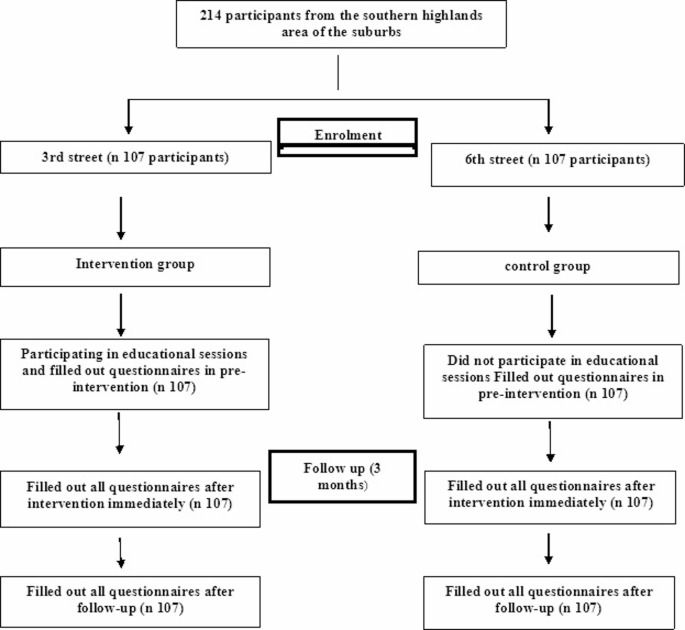
For sampling we used a cluster randomization design, two comparable streets (3 and 6) in Mashhad’s southern marginal zone were selected. Through coin toss randomization, Street 3 became the intervention group while Street 6 served as control. All eligible female residents meeting was enrolled (Fig. 1).

Flow of participants through each stage of the study.
Tools of assessment
The measurement tools were Short Test of Functional Health Literacy in Adults (S-TOFLA), Menopausal Quality of Life (MENQOL) questionnaire, and sharer self-efficacy questionnaires which previously, its validity and reliability have been confirmed in the study of Nowruzi et al.11. The Short Test of Functional Health Literacy in Adults (S-TOFHLA) is a widely recognized instrument for assessing functional health literacy, focusing on reading comprehension and numeracy related to health tasks. This questionnaire contains 36 questions, with each individual’s total score ranging from 0 to 36. In Iran, the full-length Persian version of TOFHLA (which includes the S-TOFHLA components) has been validated and extensively used in health literacy studies among adults. Studies report Cronbach’s alpha coefficients and intraclass correlation coefficients (ICC) for TOFHLA and similar instruments in Iran consistently above 0.7, indicating good reliability12.
Scherer’s general self-efficacy questionnaire consists of 17 standard questions, which are graded on a Likert scale from Strongly Disagree (1) to Strongly Agree (5). The maximum score is 85 and the minimum is 17. This questionnaire has been translated and validated by Asgharnejad in Iran13. In various Iranian studies, the Cronbach’s alpha coefficient of this questionnaire has been reported to be between 0.75 and 0.89, indicating favorable reliability14.
The Menopausal Quality of Life Questionnaire was developed and standardized by John Hildage et al. and consists of 29 questions with psychosocial (7 questions), physical (16 questions), sexual (3 questions), cardiovascular dimension (3 questions), which are graded by Three-option Likert scale. The maximum score is 203 and the minimum is 29. Golrokh Moridi12 approved validity and reliability of this questionnaire in Iran. The lower scores obtained in this questionnaire, indicate a better the quality of life.
The questionnaires were completed before intervention, instantly after the intervention, and at 3-months follow-up by participants in both groups. A demographic form was only full filled at baseline.
Educational intervention
In this study, the intervention was conducted based on self-efficacy model. The intervention was delivered through four 90-minute educational sessions. According to the self-efficacy model, training sessions were conducted based on the progress and success of the participants’ performance in activities to prevent menopausal complications and improve the quality of life during this period. The intervention aimed to realistically design goals and programs and allocate specific rewards for success small goals achieved. The details of the intervention are shown in Table 1. Educational intervention was performed by a specialist health educator at the health care center. Also, review action planning, educational pamphlets, and focus group discussion are used. During the intervention time, participants on the control side had not received any education. They accessed a training package 6 months after the educational intervention.
Statistical analysis
Statistical analysis was performed using SPSS software (version 21). First, the data were checked for normality by Kolmogorov-Smirnov. The characteristics of the participants were described using descriptive statistics. The data were analyzed using independent t-test and Repeated measures. The significance level chosen for this study was p < 0.05.
link