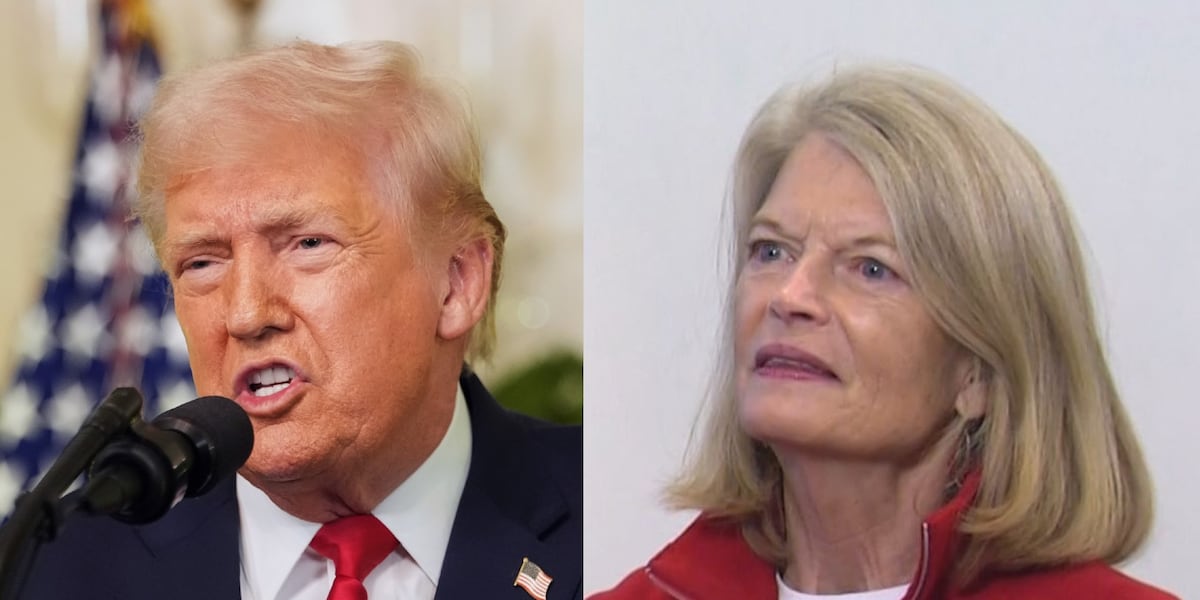
ANCHORAGE, Alaska (KTUU) – President Donald Trump publicly criticized Sen. Lisa Murkowski, R-AK, during a Tuesday meeting with House Republicans, as she and Sen. Dan Sullivan, R-AK, race against a Jan. 15 enrollment deadline to restore healthcare subsidies that expired Thursday for 28,000 Alaskans now facing dramatic premium increases.
The Jan. 15 deadline marks the last day Alaskans can enroll in Affordable Care Act health plans for 2026, though Murkowski says extending that deadline is part of her proposal.
House Republicans met with the president at the Trump Kennedy Center, where the President said he’s “trying to solve the healthcare problem,” but did not directly mention an extension of healthcare subsidies. Instead, he backed a plan touted by Sen. Bill Cassidy, R-LA, to send funding to healthcare users instead of insurance companies.
Unrelated to the current issue on lawmakers’ plates, the president did bring up his attempt during his first term at a healthcare plan — specifically calling out Murkowski on her nay vote on that plan.
“One other thing on healthcare, it’s never been our issue. It should be our issue,” Trump said. “I got a very nasty vote from a couple of people. I guess [Susan] Collins (R-ME), I guess Lisa Murkowski and I guess a man named John McCain.”
Rep. Nick Begich, R-AK, was at that meeting Tuesday morning Alaska time, his spokesperson Silver Prout told Alaska’s News Source on Monday.
Begich previously said he supported extending subsidies “with reforms” at a press conference announcing $272 million into healthcare from the rural health transformation fund, created by the One Big Beautiful Bill Act.
“In the House, we’re looking at some possible ways to extend the enhanced premium tax credit subsidy, but to pair that with durable reforms that will address the fundamental cost of care,” he said.
The tax credits, or subsidies, began under 2021 legislation and were extended in 2022. The credits expanded eligibility for lower health insurance premiums to those whose incomes exceed 400% of the federal poverty level and increased the amount of financial assistance.
“In Alaska, insurer proposed full price [pre-subsidy] rate changes for 2026 are modest,” the Alaska Division of Insurance website reads. “Alaska is among the few states where the underlying full-price [pre-subsidy] rates are essentially stable; however, the enhanced subsidies enacted under the Inflation Reduction Act expire at the end of calendar year 2025. This means the out-of-pocket premiums Alaskans pay for insurance may increase dramatically depending on your income.”
Data from the nonprofit health policy organization Kaiser Family Foundation shows premiums without tax credits can consume more than half a family’s yearly income when purchasing a silver plan.
In one more dramatic example: Two 64-year-olds earning $105,721 (401% above the federal poverty level) saw premiums jump from $749 per month with enhanced credits (8.5% of yearly income) to $4,809 per month (54.59% of yearly income).
Murkowski’s push for extension
“I want to help Alaskans avoid the cliff that is coming with the expiration of these extended premium tax credits under the [Affordable Care Act],” Murkowski said on the Alaska’s Political Pipeline podcast in late December. By that point, it was all but certain the subsidies would expire.
But despite the cliff inching closer every day, the senator wasn’t pessimistic.
“I’m hoping that we’ll be able to advance a bipartisan, bicameral initiative in the very first weeks when we get back in January,” she said.
Murkowski and Sullivan were two of four Republicans who voted against their party in December to try and pass an extension in the GOP-controlled Senate. The measure failed.
Alaska’s News Source reached out to the delegation Tuesday for insight into the healthcare push following the subsidy expiration, including follow-up questions on the push for legislation by the end of January.
Murkowski spokesperson Joe Plesha said in a statement discussions are still active, albeit slow.
“While she is frustrated by the lack of progress, given the ample time both sides have had to reach an agreement, she will continue to press forward as long as there is time left on the clock,” he said. “The consequences for Alaskans are simply too significant for her to walk away.”
Plesha said plan specifics are still being laid out, including whether those who have already paid higher healthcare prices without subsidies would receive a reimbursement.
Sullivan spokesperson Amanda Coyne said the senator is also working with lawmakers to pass a plan that “reforms Obamacare subsidies to get federal health care dollars out of the hands of insurance companies and into the hands of the people.”
“Senator Sullivan is actively working with a group of colleagues on both sides of the aisle to find a viable path forward on extending the ACA enhanced premium tax credits,” she said in a statement. “Last night, the Senator met with a group of 10 bipartisan senators to discuss solutions that include reforms.”
Jan. 15 marks the end of the enrollment period when consumers sign up for their plans. If that day comes, Murkowski previously said, there still isn’t reason to give up hope.
“One of the provisions that we have included in ours is extending that open enrollment period,” she said. “You will have that ability [to sign up for healthcare and] to adjust, assuming that we are successful with this.”
To get a plan through Congress, it’ll need the votes to pass in the GOP-controlled House and Senate. Murkowski said White House support would help it get across the finish line.
“The White House needs to be involved in this topic,” Murkowski said. “It seems that one way Speaker Johnson can get the support that he needs within the Republican conference is when the White House weighs in.”
But the president has yet to signal any support for a subsidy extension—a fact true when Murkowski was asked about the subsidy extension, and also true today.
Sullivan is working on two fronts: pushing for an extension of the expired subsidies with reforms, while also backing the rural health transformation fund that passed under the One Big Beautiful Bill Act.
“The broader reforms are to take that money, not for the insurance companies, get it to Alaskans directly—let them choose through what we call health savings accounts on where to spend that money,” Sullivan told Alaska’s News Source in November. “To get there, I think you need a two-year extension with reforms.”
Impact on Alaskans
Genevieve Mina, D-Anchorage, House Health & Social Services Chair, said Tuesday there’s little state lawmakers can do to alleviate the burden on Alaskans using the Affordable Care Act, given the state’s economic situation.
“The result of these tax credits expiring has resulted in Alaska starting to go without health insurance,” Mina said, explaining what she’s been hearing and seeing from community members and online reaction.
“The main impact isn’t just that someone’s going without health insurance, but they’re trying to make a difficult decision on whether they can afford to pay their mortgage or to run their business and have health care coverage at the same time,” she said.
The state legislature passed a joint resolution in May urging Congress to “extend enhanced tax credits for health insurance premiums under the Affordable Care Act.” The measure, drafted by Mina, passed with 14 House Republicans and five Senate Republicans voting against it. All five Senate opponents were Republicans, except Sen. Kelly Merrick, R-Eagle River.
House Minority Leader Mia Costello, R-Anchorage, voted against the resolution but previously told Alaska’s News Source her vote wasn’t so much against the tax credits, but rather the system in general.
“I do understand that there’s some hardship with small businesses and individuals, with the high cost of health care and Obamacare,” she said, later saying she supports Cassidy’s plan to pay individuals. “My vote on that resolution had to do with the fact that I think Obamacare is a flawed health care system, and my interest is in fixing the system so that it’s affordable for everybody rather than subsidizing a high-cost system that is unaffordable.”
See a spelling or grammar error? Report it to [email protected]
Copyright 2026 KTUU. All rights reserved.
link